

 Magic Library
Overview
Thread’s AI features are purpose-built for MSP technicians and service teams. Partner privacy and security are foundational to how they’re designed — both on the model paths described here and in the workspace controls that admins use to enable them. Thread’s AI features run on two model paths, both hosted in the United States and both bound by “no training on your data” terms:
Both paths keep partner and customer data isolated to your workspace, encrypt data in transit and at rest, and never use your data to train or improve any model. For the deeper Bedrock walkthrough (data flow, retention, tenant isolation, and Anthropic’s non-access to your data) see Claude on AWS Bedrock.
Voice AI uses separate providers (LiveKit, Cartesia, Azure OpenAI, and Azure Speech) and is documented separately.
Foundational controls (both paths)
We understand the importance of privacy and security — especially when it comes to early use of emerging technology such as large language models (LLMs), generative artificial intelligence (AI), and generative interfaces. Every Thread AI feature begins with the following foundational controls and principles.1. Your data is not stored by the AI service, nor is it used for training or re-processing.
- Partner and customer data is not retained by the AI models Thread uses.
- Data required for prompt execution (documented below) exists only in memory for the duration of the request; it is not stored, and it is never used to train or improve any model.
2. Data sent for prompt execution is limited to the ticket and contact context needed to run the requested action.
Depending on which feature runs, this can include:- Contact first and last name
- Contact email and company
- Contact type (as defined in the PSA)
- The date and time the action was run
- The ticket’s board or source
- The ticket’s summary, initial description, and conversation transcript
3. Access to Thread infrastructure and hosted services is limited using the principle of least authority.
This covers AWS infrastructure (including Amazon Bedrock), Microsoft Azure portal, Azure OpenAI Service, and underlying Microsoft services. Violations of Thread’s internal Acceptable Use Policy will result in disciplinary action, up to and including termination.Azure OpenAI Service (assistive AI)
Thread’s assistive AI features are built on an integration to Microsoft Azure OpenAI Service. Our MSP partners benefit from the enterprise-grade and highly-secure Azure cloud.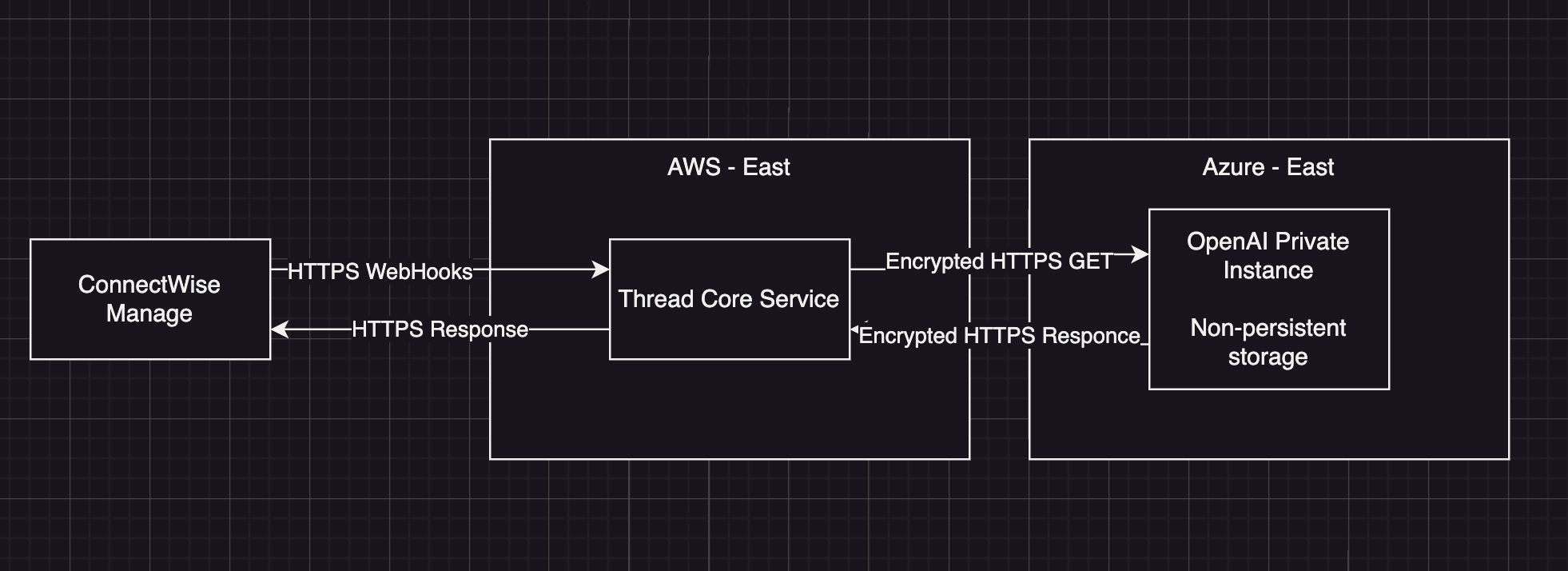
Assistive AI reference architecture (Azure OpenAI).
- Isolation: Thread’s Azure OpenAI Service instance is isolated so that partner data is not shared across other Azure OpenAI customers.
- Content filtering: When data is submitted to the service, it is processed through Microsoft’s content filters as well as those built in to the specified OpenAI model. The content filtering models are run on both the prompt inputs as well as the generated completions. No prompts or completions are stored in the model during these operations, and prompts and completions are not used to train, retrain, or improve the models.
- Control: Microsoft hosts the OpenAI models within the Azure infrastructure, and all customer data sent to Azure OpenAI Service is encrypted and remains within Azure OpenAI Service. Microsoft does not use customer data to train, retrain, or improve the models in the Azure OpenAI Service, and neither does Thread.
- Data protection: Your data is not used to train or enrich the foundation AI model that is used by others. Nor is any data shared by Microsoft to OpenAI for improvement of their models. This means you can be confident that your data is only being used for your own purposes and that you have complete control over how it is used.
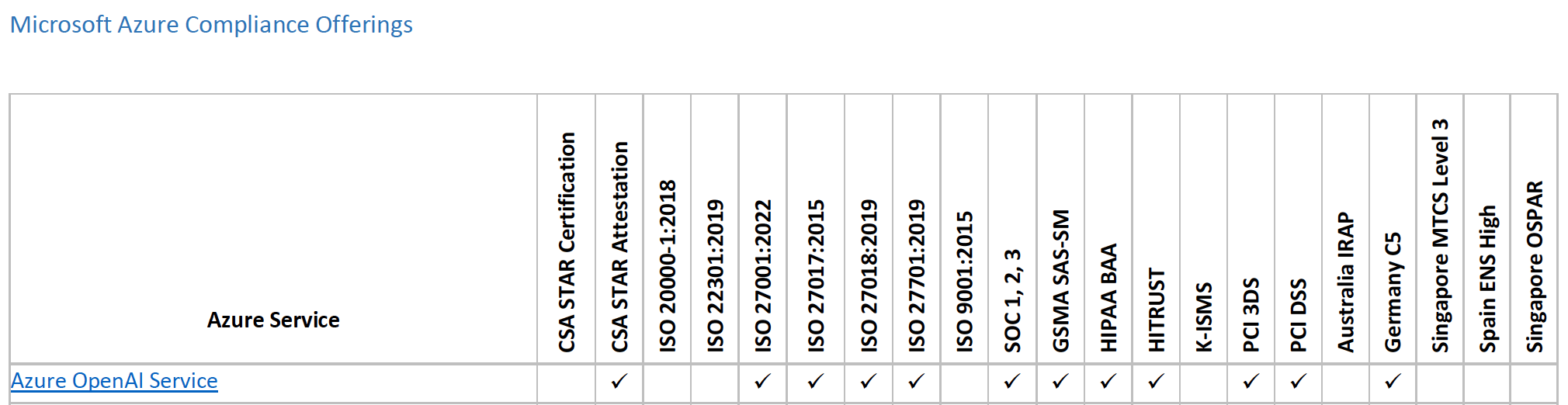
- Compliance and security: The Azure OpenAI Service is protected by Microsoft’s enterprise compliance and security controls, so your data is protected at every step — from storage to processing to destruction. For the current list, see Microsoft’s Azure compliance offerings.
Anthropic Claude on AWS Bedrock (Triage Agent and Super Magic)
Triage Agent and Super Magic run on Anthropic’s Claude models hosted on AWS Bedrock in the United States. Requests travel over an encrypted AI gateway (Portkey) to AWS Bedrock, which runs the model inside AWS infrastructure. Under AWS’s published Bedrock terms:- Your inputs and outputs are not used to train any model.
- Your inputs and outputs are not shared with the model provider (Anthropic).
- Data is encrypted in transit (TLS 1.2+) and at rest.
- Anthropic has no access to Bedrock customer prompts, completions, or logs.